
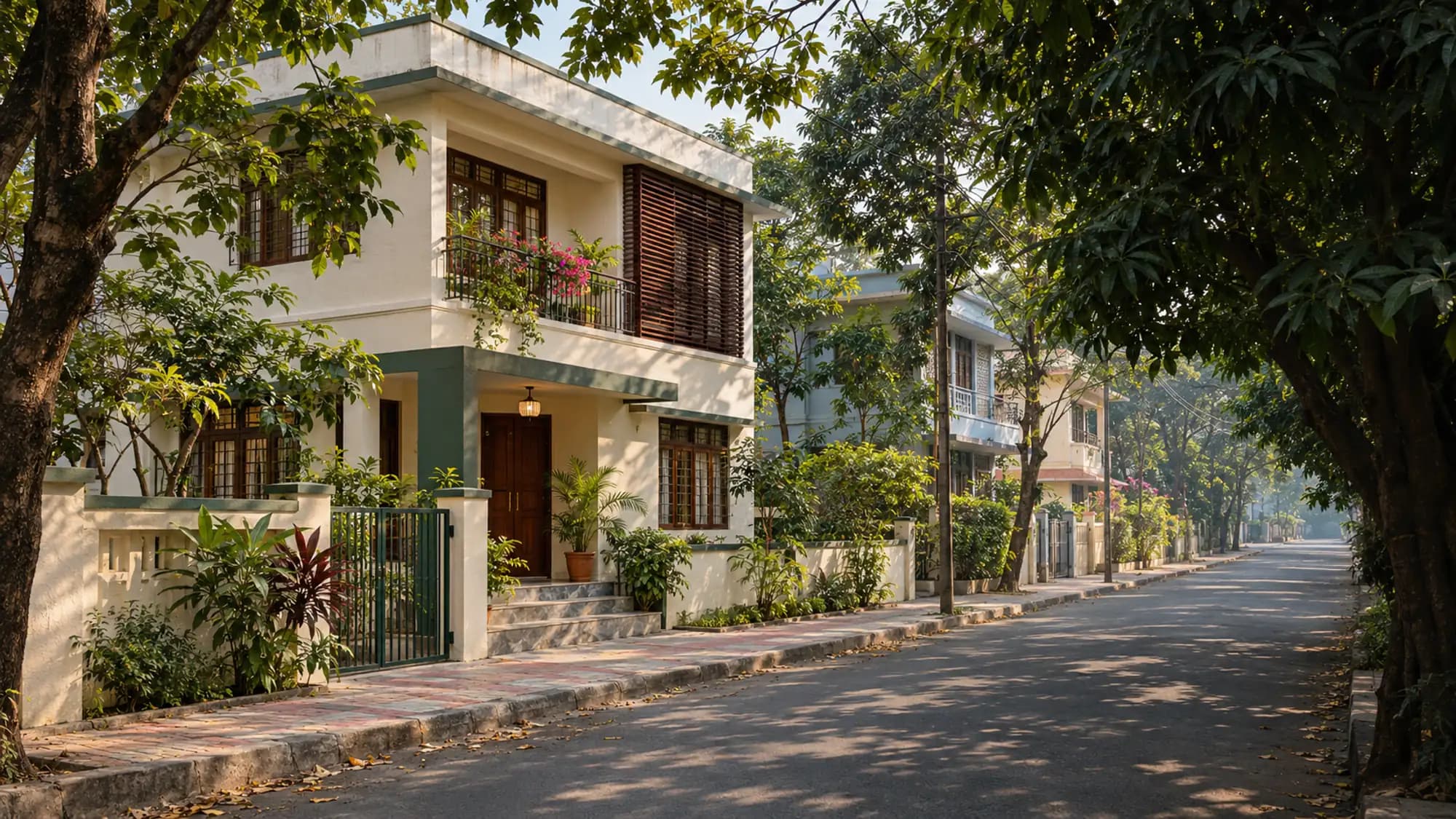


Develop your land
If you already own land, we help you understand what it can become, plan the next steps and, if you wish, carry them forward with a team that builds.

Free enquiry·
Tell us what you are looking for
- We read your papersAnd look at the land itself
- Options in plain wordsWhat each needs and involves
- You chooseWhether to go on, and how
- Written downAgreed in person and in writing
Trusted dealer
Ask about the property and its papers.
Transparent price
Ask what is included, in writing.
Flexible EMI options
Estimate it, then check with your lender.
Free site visits
See it yourself; we fix the day with you.
From a plot you own to a plan you can act on
Owning land is the beginning of a decision, not the end of one. It may be a plot to build a home on, a larger parcel that could become a small project, or land that has sat unused for years.
We begin by looking at what you have: the papers, the size, the road, the surroundings and what the rules of the area allow. Then we set out the options in plain words, with what each would need from you. You choose whether to go on, and how.
Nothing is agreed on this website. Any arrangement is discussed in person and written down, and you keep your own adviser at every step.

Who this is for
Owners of a family plot
You hold land from the family and want to build a home or a small block on it.
Owners of larger land
You hold a bigger parcel and want to know whether it could become a layout or a project.
Owners who live elsewhere
You live away from the land and want a person you can talk to, in your own language, who can look at it on the ground.
How it works
We listen and read the papers
You tell us about the land and what you hope for. We read what papers you have.
We look at the land
A visit to see its size, its road and its surroundings, and a look at what the local rules allow.
We set out the options
Each option in plain words, with what it needs from you and what it involves.
You decide, and we write it down
You choose whether to go on. If you do, the arrangement is agreed in person and in writing.
What we need from you / What you get
What we need from you
Bring what you have. If something is missing, we will tell you what it is for and where it is usually obtained.
- The land's papers: title documents, the record of rights and recent tax receipts.
- A survey map or a sketch, if you have one.
- Your aim: a home, a layout, a sale or a joint project.
- Anything you know about disputes, loans or claims on the land.
- The people who must agree, such as co-owners and heirs.
What you get
The point of the first conversations is clarity. You should leave each one knowing more than you did.
- A plain-language reading of your land and its papers.
- The options in front of you, with what each needs and what each involves.
- A list of the approvals and professionals a plan like yours would need.
- A clear next step that you can take or leave.
- A written note of what was discussed, so nothing rests on memory.
This is general information, not legal advice. Rules differ by place and by property, so take advice from a lawyer you trust before you sign anything.
Need anything else?
Whatever the property question, tell us what you need.
Land search and site selection
Yes, we can help you look for land. Tell us the size, the area and what you plan to do.
Tell us what you needPlanning and infrastructure
We can help you think through a layout, roads, drainage, water and power before you build.
Tell us what you needPaperwork, loan and registration help
We can help you gather and understand the documents, and prepare for a home loan and registration.
Tell us what you needSelling or resale
Want to sell a plot, flat or house you own? Tell us about it and we will say how we can help.
Tell us what you needNRI help
Living outside India? We can keep you informed and help your family on the ground.
Tell us what you need
What we can take on depends on the property and the place, and we will say plainly if we cannot. Approvals, loans and registration are decided by the authorities, the lender and the registry; legal and tax advice comes from your own adviser.
Want to talk this through? Call or message us.
Watch before you visit
Short videos of homes and sites, to help you look closely before you come to see them.
2 BHK on the 10th floor at Shyamnagar, river view: home tour
Sodepur residential plots in a municipality area: site view
Shriram Grand City: ready 2 BHK with car parking, flat tour
Check the carpet area before booking a flat: buyer tip
Sodepur Premium Plots: development work on the land
Shriram Grand City: 3 BHK flat tour in Uttarpara
Ask about anything you saw, or book a site visit.
What people ask us
First the questions about this page, then the ones people ask about working with us.
What should I bring to a discussion about land I already own?
Bring the title papers, current land records and any drawing you have, together with your aim for the site. Explain known loans, claims or boundary questions accurately. The initial discussion should identify the information available and missing, rather than treating ownership alone as a complete plan for development.
How do I describe my aim without committing to a scheme?
Explain the purpose you are considering, such as a family home, a layout or another proposal, and what matters to the owners. Ask for options and the information needed to examine each. Keep an exploratory discussion distinct from an agreement to carry out a particular design or construction programme.
What if several relatives or co-owners have an interest?
Identify the people and documents relevant to the ownership and decision-making arrangements. Ask your own advocate how their interests and any representative authority should be addressed. A conversation with one family member should not be assumed to establish the agreement of everyone whose rights or instructions matter to the proposed work.
Why look at the site before choosing a development option?
The actual approach, boundaries, surroundings and physical condition help frame the questions a proposal must answer. Compare those observations with the records and seek the relevant professional checks. A site visit can inform an option, but it does not itself settle the land-use or building decisions required for that option.
What if my land records and an old sketch do not match?
Keep both records and identify exactly where the description differs. Ask the team which documents are missing and have your adviser or survey professional examine the discrepancy. Do not redesign the boundary simply to fit an old sketch before the land offered for the proposal has been properly identified.
How should an owner living elsewhere arrange the first review?
Provide the site identifiers and a clear contact arrangement for access, then agree what should be observed and documented. Keep the visit notes and supplied papers available to your independent adviser. A local contact can assist with coordination, while decisions about ownership, professional findings and the proposed scope remain yours.
What should an option note explain to a landowner?
Ask for the purpose of each option, the information still needed, the people involved and the decisions that would come next. Identify dependencies instead of treating an outline as a settled scheme. A useful note lets the owners compare the work involved without implying that a particular outcome has already been agreed.
When should a surveyor, architect or advocate be involved?
Ask which questions the proposal raises and which professional is competent to answer each. Boundary measurement, building design and title review are different tasks. Keep their instructions and findings identifiable so a general service discussion is not mistaken for a survey, technical design or legal opinion addressed to the actual site.
How should I disclose a claim or dispute affecting my land?
Describe what you know and supply the relevant record privately to the appropriate adviser. Distinguish a reported concern from an established finding. Ask how the unresolved issue affects the options being discussed and record any dependency before you agree further work or allow a description of the land to be used.
What should we write down before moving beyond the options stage?
Record the selected purpose, exact site, agreed tasks and responsible decision-makers, together with information still required. Identify which steps depend on professional advice or an external decision. Keep scope changes written so an initial discussion about possibilities does not become an assumed instruction to proceed with every part of development.
What is Versatile Realty, and what is it not?
We are a real estate practice that guides buyers, landowners and developers: finding property, explaining the papers, arranging visits and presenting projects. We are not a bank, a lender or a law firm, and we do not give legal or tax advice. Please take that from a qualified adviser of your own.
How is a site visit arranged?
Send the enquiry form, or use a contact button on the page. A person from our team calls you back, suggests the projects worth seeing and agrees a day and a time that suit you. We then take you to the site. There is no charge for asking, and you may change the day if your plans change.
Who may contact me after I send an enquiry?
Our team, on the number or e-mail you gave us. We use your details to answer your enquiry and to arrange visits. The Privacy Policy explains how they are kept, for how long, and how you can ask us to correct or remove them. Please read it, and ask us if anything is unclear.
How are my details kept?
Your enquiry is kept in a protected back office. If it is about a project listed by a partner company, that company's team can see it too, and nobody else. The Privacy Policy sets out what we keep and why, and what your rights are. You can write to us at any time about your details.
What does this website not do?
It does not sell a property online, and it does not make a booking for you. It does not promise a price, a date or a result. A price on a project page is a starting point until it is written in an agreement with the seller or the developer. Always ask for the papers.
Which languages can I use?
The website, its forms and its enquiry pages work in English, Hindi and Bengali, and you can switch from the menu on any page. When you speak to our team, tell us which language you prefer and we will try to talk to you in it.
What is an associate?
An associate is an independent broker, consultant or channel partner who joins our partner network to bring buyers or projects to us. People register on the Become an Associate page, and their enquiries are kept apart from buyers' enquiries. The terms are agreed with each associate in writing.
How do I list a project as a partner?
Open List your project and send the three short steps: about you, about the project, then its details and pictures. A person on our team reads every listing, may ask you for changes, and publishes the page only after our own checks. A company that wants a sign-in for many projects is agreed in person.
Want to talk this through? Call or message us.
Tell us what you are looking for
Share a few details and an advisor will call you back.
Free enquiry·
Tell us what you are looking for
Prefer to talk? Call or message us now.